

Have you ever had strawberry jelly for breakfast? And six different types of biscuits to go with butter and homemade jam? Freshly squeezed orange juice as well as whole fruits and bananas in all-you-can-drink-or-eat amounts respectively? Well, if this sounds like your cup of café con leche, then stay at the Hotel La Española in Asunción.

A quick note on paying by credit card in South America – businesses may ask for a surcharge for this convenience. As it would have added 10% to my bill, I thought, good that I had gone to the bank the previous evening, and handed over hard cash instead.
One of the impressively strong chambermaids and the hotel’s factotum, Gustavo, helped me carrying my luggage to the bike. Whilst packing, I had a nice chat and some Maté with Gustavo who could hardly believe that I was travelling through South America on my own…

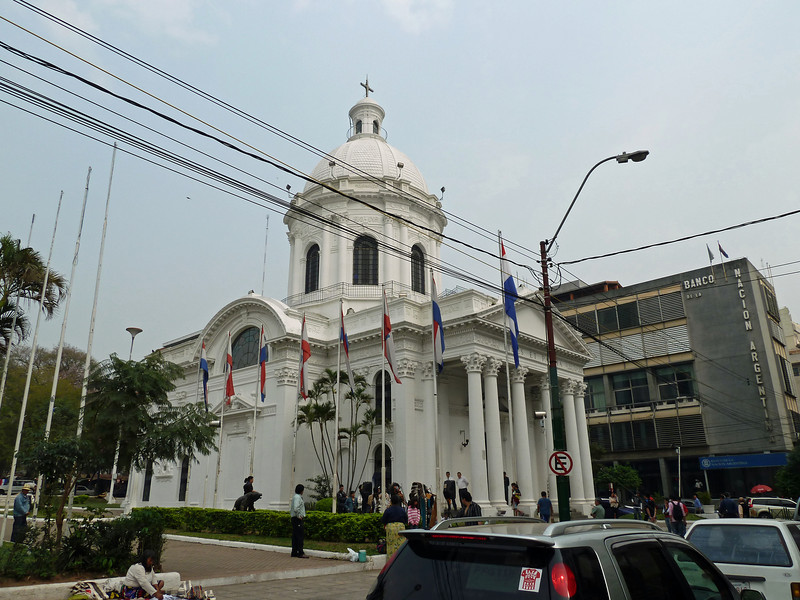
Then I hurled myself into the thick of the inner-city traffic, making my way to the Plaza de Héroes for a photo of the Pantheon of the Heroes in daylight. While I was standing by the side of the road, several car drivers stopped and asked if they could take a picture of me! There are not a lot of motorcycle travellers coming through Asunción, I suppose…
Somehow I seem to be attracted by old trucks… 

Finally I got to the president’s palace and pulled over to take a picture. Immediately one of the armed guards appeared and told me to get moving again – no vehicle is allowed to stop in the security zone.

Mmm, do I look like the typical terrorist carrying a rocket launcher in her saddle bags? Can I not just take a touristy photo of this beautiful building? Later I learnt that during the 35-year long dictatorship of General Stoessner even looking at the Palacio de Gobierno was at a time punishable by death. 
Still, slightly miffed I carried on to the next corner, but then Alberto came over and everything was alright. I thanked him again for his time and friendliness, he kept emphasising how impressed he was by my courage to cross the wild Chaco alone (gulp…) and then we had to say ’adios’.

I still looked at some of the capital’s monuments – the Cabildo de Asunción on the Plaza de la Independencia, which served as parliament, city hall and legislative palace in the past and is now a cultural centre and museum. Not sure about the colour scheme, to be honest…

The Memorial of the Marzo Paraguayano

The slums are right next to the government buildings, so that the public servants don’t forget this part of the Paraguayan people when they decide on laws and policies…

Finding my way out of Asunción was relatively easy following the excellent ConoSur mapping software from the Argentinean GPS forum – just the traffic was a bit crazy. It’s the survival of the fittest here or – in this case – of the biggest vehicle: as soon as I left more than 90 centimetres of a safety distance, cars pushed into my lane, colectivos just pulled away from the bus stop as soon as the last passenger’s feet were off the ground – without looking behind, of course; trucks bullied everyone smaller than themselves by simply ploughing their way through the chaos, etc. It really helps to have four sets of eyes…
At the checkpoint before the bridge over the River Paraguay two cops stopped me and started an interrogation. One of them wanted to see my passport, international driving licence and vehicle registration; the other just wanted to know everything about my trip, the bike, the SPOT around my arm and how it all worked. The first officer must have felt a bit left out because he demanded more documents, but then gave up when he couldn’t think of any additional paperwork that a foreign traveller could possibly present. Anyway, I had everything in order – I’m German after all  – and in the end he relaxed, started to smile and joined in the conversation.

Then I was on the Ruta 9 – the notorious Trans Chaco. 744 km / 462 miles to go to the Bolivian border.

In the next village I stopped at a service station to buy water. They didn’t have any and also advised strongly against drinking tap water, but the team was eager to help me in some way. The only thing I could think of was to ask if I could lube my chain while I was there and immediately they brought me a little can of oil and a rag and lifted the back of the bike (with all the luggage!) to make it easier.
In the meantime I answered loads of questions and an elderly gentleman told me about the history of the region, which was populated mainly in the second half of the 19th century during the construction of the Paraguayan railway. The descendants of the many migrant workers from France, England, Germany, Italy and other countries still live in the area and create an interesting multicultural mix.

The Gran Chaco is a vast plain – sparsely populated, hot and semi-arid. The Ruta 9 stretches to the horizon (of course, it’s cheaper to build a straight road – even the old Romans knew that already…), bushes and palm trees dot the countryside with a few small-holdings and cattle thrown in between. The tarmac was fresh and the riding not particularly exciting, but I was aware that the conditions would change the further I got away from Asunción and so I just enjoyed what I had at the moment.
The GPS indicated a filling station near Río Negro (km 180 of the Ruta 9) but there was no electricity and so the pumps didn’t work. Mmm, I still had fuel for at least another 110 km / 70 miles and the next services were 72 kilometres away, so it should be ok. Bathroom, two bottles of water, a cold empanada – and off I went again.
After a while the tarmac became patchy and huge potholes opened up, causing the traffic to meander around them. I had already been wondering why those trucks in the distance approached me on my side of the road… The trip counter showed 200 miles when I turned the fuel tap onto reserve. In Pirahú (km 252) they had petrol but not the 95 octane type I needed! My hopes were set on Pozo Colorado, a further 21 kilometres up the road.
Finally! The attendant filled 14.2 litres into my 16 litre-tank… I would still have had my extra can of five litres in the worst case scenario, but there was a lesson to be learnt: when in remote areas in South America – stock up on water and fuel at every opportunity, even if your hydropack and tank are still half full.
It was around 5 pm and I could have looked for accommodation in Pozo Colorado, but the South American Handbook had recommended the Rancho Buffalo Bill another 14 kilometres northwest. At km 283 I stopped in front of the hotel and – in anticipation of a nice shower and a good meal – walked towards the gate.
After a while, an elderly, toothless señor answered the door, but only to inform me that the supply of both water and electricity had been cut off and that, therefore, the Rancho was closed. I could either return to Pozo Colorado or carry on to Fortín Río Verde. Well, I really don’t like turning back and so I rode another 40 kilometres onwards. At this rate, I would possibly make it to Bolivia by midnight… 
In Río Verde I found a service station, a restaurant and a few cottages. From the air the place looks like this:

Is there any accommodation around here? I asked at the guys at the pumps. At first, they shook their heads but then one of them pointed to the other side of the road. Over there, the señora rents out a room some times. Well, let’s hope she does so today…

A Guaraní woman opened the door and then called the owner. Yes, she had a bed and if I would like to wait a minute, un ratito, she would prepare the room for me. While Norma was busy, I talked to the fine little lady sitting on the patio. It was actually her house where she was living with her son, his wife and their children; she was 78 years old, with an agile mind but suffering from an illness that made her frail and fall over. Still, she insisted on showing me my room – it was actually a small house –
¡Mi casa!
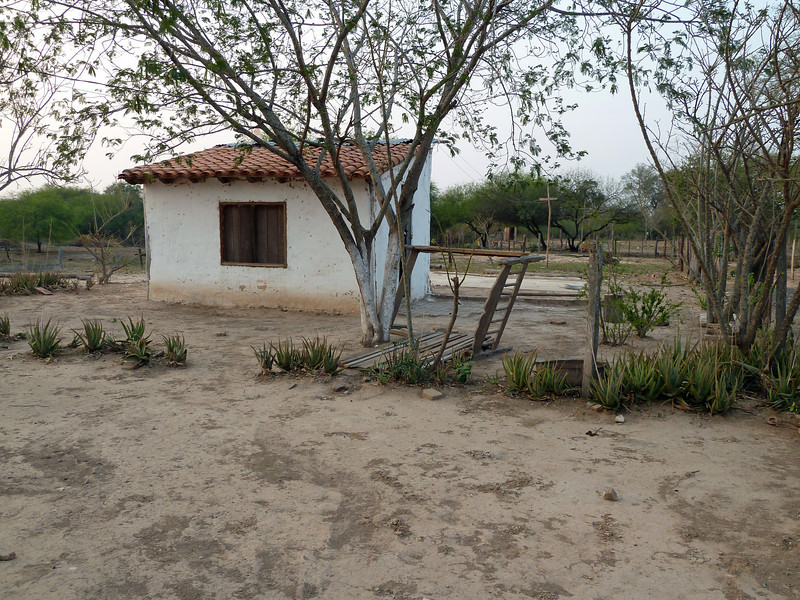
Inside it was basic but clean.


… and I even had electricity. Otherwise there were no modern amenities such as running water or sanitation on the farm. They had a well but the water had to be heavily chemically treated to make it drinkable. Apart from that, a tanker would come round once a week to provide the village with potable water.

The family didn’t have a shower but Norma heated some water on the wood-stove, handed me a jug, a bowl and soap, and showed me their bathroom where I could have a wash. It seemed like travelling back in time and reminded me of my old student days when I lived in a tiny apartment which only had a toilet but no shower or bath tub. Here, the toilet was actually a pit latrine in the garden.
Standing there in the dimly lit room, relishing the peaceful environment and hugely enjoying the whole experience, I contemplated the living conditions here in the Chaco in comparison to the standard I had become accustomed to in Western Europe. The family didn’t possess any of the technical comforts that appear so indispensable to me and still, they all seemed happy and content with their life.
I was even more amazed when I learnt that Norma had grown up in Asunción, where she had also met her husband Joel. Only when his father died, his mum asked if he would move back to Río Verde to look after her and the house. What a contrast it must have been for Norma and the children to swap life in the modern capital with this remote little village. And the family was relatively well off here in Río Verde: they had a big house, a farm, a shop, the small guest house, Joel had a job in Pozo Colorado and they employed a Guaraní couple to help them.
Norma, Joel and his mother

I was wondering how life must be for the indigenous people around here. Joel actually warned me – I should not leave my bike outside and always lock the door to my room. The Guaraní were so poor that they would steal anything, he said. Due to our own history in Germany I am very sensitive to pejorative comments like this and any racist tendencies but I didn’t know enough about Paraguayan past and present to argue and also couldn’t talk to the Guaraní couple themselves, as they had retired to their room by then.
So I just listened, asked more questions and gratefully accepted Joel’s offer to push my bike into my cottage and then, when it turned out to be too wide to fit through the door, into their own house for the night. Norma asked if I wanted to go to the restaurant or share their dinner with them. Of course, I went for the latter option. 

It had been a long day – battling the traffic in Asunción, the police interrogation, the pot holes and the solitude on the Trans Chaco, the hunt for fuel, the friendliness of the people and then all the things I had learnt about life in Río Verde – there was a lot to digest and think about.
What a multifarious experience this journey through Paraguay was. And it wasn’t going to stop there.


 Pumpernickel on Tour