Archive for April 2011

It was really interesting that the majority of people who replied to my question “what would you have done?” would have gone for the bribe.
Personally, I find bribery wrong on so many accounts: corruption has been and still is destroying countries and societies, especially in the developing parts of the world; it undermines the law by exempting the rich from following the rules and it degrades travellers to cash cows who are only appraised for their milking potential. So I had taken a vow before the trip that I would not pay anyone for anything that should be free – such as crossing from one country to another, for instance.
Also, I don’t like putting myself into a position where I am at someone’s mercy. The knowledge that my bike, my luggage and all my documents were in order contributed a great deal to my confidence and demeanour when talking to officials at borders, customs or police checks on the road.
And even if I had considered bribing the Bolivian border official – he might have asked for more money than I would be willing to pay or sent me back anyway (because he could…); then I would have had to ride the 70 kilometres of horrible dirt track three times plus the 460-kilometre roundtrip to Mariscal and back on top, meaning that I would also lose another day in the process. That was not a risk I wanted to take.
So during the night I decided to return to Mariscal to get the required exit stamp. I had enough fuel, could leave the luggage at the border post and, when I started as soon as Juan Carlos began his shift at 6.30am, I would also have enough time after getting back to Mayor Infante Rivarola to carry on to Villamontes, the nearest town in Bolivia.
The morning did not start well though: we overslept and were only woken up by Gilberto, Juan Carlos’s replacement from the capital Asunción (the border officials work 15-day shifts at this outpost before they return home to their families). I had a few biscuits and water for breakfast, filled the content of my fuel bladder into my tank and set off just before 9am – two and a half hours later than planned…
However, I made good progress, saw the French cyclists again (I wondered where they had slept during the night…) and arrived in Mariscal at a quarter to twelve. Finding the Oficina de Migraciones was not a problem; the official didn’t ask any questions, he only wanted to see my passport and added the desired exit-stamp; done. Stepping out of the building, I ran into a group of small Guaraní kids who were waiting for foreigners to beg for money – an embarrassing and at the same time heartbreaking scene.
I stocked up on fuel, water and chocolate and made it back to Infante Rivarola by 4pm. The soldiers at the military post already knew me by now and just waved me through. At the border, I quickly packed my luggage, said goodbye to Juan Carlos, Gilberto and the other boys, thanked them very much for their hospitality, gave them the rest of my Paraguayan cash and set off. It was still 120 kilometres to Villamontes and there were only two hours of daylight left. It was getting dark at 6.20pm at that time but a few minutes of riding in the night would not do any harm, I thought. Famous last words…
Immediately after crossing the border with Bolivia, the tarmac ended and the road changed to a sandy, stony, corrugated dirt track.

Big trucks were coming the other way, driving without lights, creating lots of powder clouds, leaving me blind for a few moments so that I had to stop frequently to let the dust settle. Then I reached a Bolivian military control post where I had to show my passport and bike registration and explain where I was coming from, where I was going to and if I had anything to declare. A few soldiers proudly demonstrated their English skills and tried to engage me into a longer conversation – but the clock was ticking and I had to crack on.
After 50 kilometres of struggling with ruts, corrugations and trucks, I reached tarmac and ran into another military post. Two hours to Villamontes, they said – what, for 70 kilometres?! I understood what they meant when, after only 500 meters of asphalt, the road diverted me on to the dirt track again. By now it was getting dark but I was still doing 45 km/h. Then suddenly I hit sand! Screaming but still upright I passed the patch. Through the next dodgy bits I tried different riding techniques and then disaster struck – I lost the front end and laid the bike on its left-hand side.
There was no way that I could lift the DRZ without removing all the luggage. But the bike was lying in the middle of the road and I was fearing and hoping at the same time that another truck would come along. After five minutes I heard an engine roaring, so I switched the lights back on and flashed SOS. The truck stopped – but nothing happened. The driver stayed in his cabin and I had to walk towards him and ask if he could help me. He did – without speaking a word though. Only later did it dawn on me that he might have been wary of a trap and equally scared as me.
After that incident I took it very easy, even paddling through the sand patches, as I could not afford to drop the bike again – the traffic had died down completely. It was pitch-black by now but I was approaching 70 kilometres and expected the Bolivian border post to appear around the next corner. Nada – nothing. I heard a few dogs barking, hoped again, but still – nothing. From every light reflection in the trees I drew hope but it was only my own headlight illuminating the leaves. Then the engine died. I had switched to reserve only a few miles back but for some strange reason the tank was already empty.
In the dark I had to get the tools out and undo all the bolts from my luggage rack to remove the reserve fuel canister. Everything was dusty and caked and hence the can was a very tight fit – maybe also due to the fall earlier. I almost dropped the bike off its side stand during the effort of pulling the container out. Then – where was the funnel? Ah, in the tool tube, its lid also very sandy. After 20 minutes I finally had everything re-assembled (including myself after a short excursion into the bushes) and the trusty DRZ started straight away. During all this time I had not heard a single thing apart from some strange animal sounds.
Well, I was down to between 15-20 km/h because I couldn’t see much and there was a lot of sand on the track. But I thought, ok, at some point I will arrive somewhere, so I just keep going. 50 kilometres to Villamontes equals 2.5 to 3.5 hours at that speed and it was 7.45pm. Camping in the wilderness was just not an option with the Río Pilcomayo nearby, alligators and all the other animals around that the border guys had told me about. Slowly, slowly I made progress, after every corner I expected the border post, with every road sign I was hopeful I would be nearing civilisation – but still nothing… At least the GPS showed that I was on the Ruta 11, the main road between the border and Villamontes…
Finally, after ages I spotted a pick-up truck with two men outside by the side of the road. They may be smugglers but more importantly they were humans, thanks God for that! Is it still far to Villamontes? No, just 20 kilometres and there is tarmac around the corner. Phew!
I turned round the mentioned corner and yes, there it was – glorious asphalt! After a while, the road was even equipped with cat-eyes and I could accelerate to 45 km/h, as there were still the cattle crossing the road without looking to be wary about. At 9.05pm I rolled into Villamontes, the Promised Land. It was bigger than I had thought but I could not find the hotel I had planned to stay in. So I stopped in front of a restaurant and asked if they could point me to any means of accommodation. I must have looked really knackered and confused, because in the end, a nice young man jumped into his car and guided me to ‘El Rancho’, the best hotel in town – but I thought I had deserved it.
The welcome was great – everyone at the hotel was truly concerned and did everything to make me comfortable, helped me unloading the bike, carried my luggage, said I should not worry that I was so dirty and didn’t have any local currency yet, and they even kept some dinner for me so that I could have a shower first. And the room was just heaven – spacious, clean, good quality furniture, big bathroom with all the trimmings, fantastic. I was so relieved and so shattered that I thought I would treat myself to two nights (even at US$32.00) to relax thoroughly. I also had to maintain the bike after this ride, get some local currency and sort my official entry into Bolivia out.
Hopefully there was an immigration office in town and with any luck they wouldn’t ask too many questions…

At the break of dawn I finally calmed down. Ok, there might be horrible road conditions, shifting sands, very few settlements, no services at all but smuggler gangs on the notorious Trans-Chaco, but I would just see how far I could make it this day. Maybe it was only from Loma Plata to Mariscal Estigarribia, 112 kilometres ahead, where I could get fuel and supplies and even a hotel if the road turned out to be too bad. Maybe I would meet other travellers on the way and could team up with them for the journey to the Bolivian border. Or maybe it wouldn’t be so bad after all…
A sumptuous breakfast buffet – Müesli, yoghurt, home-baked bread rolls, real butter, cheese, fresh fruit and delightful café con leche – lifted my spirits further. While I was packing, Mr Sawatzky came along and I told him that I had thought about the risks he had warned me of and that I would probably only ride to Mariscal today and continue to the border tomorrow. Oh, I shouldn’t worry so much, he said, I could at least carry on to La Patria, 116 km after Mariscal; there would be accommodation, too, and then I would have covered a large portion of the route already. I was relieved and really grateful for this reassurance. Annette gave me a big hug when we said goodbye and then I was off.
Straight after Loma Plata I ran out of tarmac and rode sandy dirt tracks until I reached Filadelfia, another one of the German-speaking Mennonite communities in this part of Paraguay.

Filadelfia, the centre of the Fernheim Colony, looked even neater than Loma Plata. I could have stayed on tarmac from here but that would have involved going back a bit; so I took the shorter, more direct dirt track which was not necessarily faster, as you may have suspected… The road turned out to be sandy and slow but some times I could take my eyes off the track and admire the fascinating Bottle Trees.

After joining the paved Trans-Chaco again, I arrived in Mariscal around lunchtime. At the services I bought six litres of water and filled up the bike’s tank, spare canister and fuel bladder (29 litres in total), as there were no filling stations between this last outpost of civilisation and the next town in Bolivia, Villamontes, around 500 kilometres / 310 miles away.

The attendant looked at me very sceptically when he learnt that I was going to cross the wild Chaco on my own, but when I told him a bit more about my trip, he willingly gave me some valuable advice on the route ahead. He wasn’t aware of the direct road to the west which was charted in my map but he confirmed Mr Sawatzky’s view: I should carry on north; there would be another village half-way to the border, La Patria, where I could get fuel and accommodation.
So after some chocolate, nice chats with the locals and a longish break to build up my courage, I decided to continue. It was 116 kilometres to La Patria, and every minute I expected a road sign Fin de pavimento, pavement ends. But no, the asfalto continued stretching to the horizon.

Up to kilometre stone 550 that was (Mariscal lies between km 526 and 530 counting from Asunción, if I remember correctly). Then the Ruta 9 suddenly became muy feo, very ugly: the deepest potholes I have ever seen in my life opened up in front of me, requiring advanced slalom skills for the next 80 km / 50 miles – until kilometre 620, to be precise, when the tarmac smoothed out again.

This rough bit cost me one of my precious water bottles and a few litres of fuel: it’s the custom in South America that the attendant fills up your tank rather than you doing it yourself. In Mariscal I hadn’t been quick enough and the otherwise very skilled and knowledgeable señor had ripped off the rubber seal of my Clarke tank lid by accident – to the effect that every time I hit a bump, fuel spilled over the edges. Great, especially as the petrol had to last me at least 500 km / 310 miles…
There was very little traffic; I only met three vehicles and a few gauchos with their cattle in two hours, and just after 3pm I already arrived in La Patria. I rode through the village, as I had two options from here: following the Ruta 9 northwest to Boyuibe in Bolivia, a route mainly used by smugglers and the police coming after them, or heading to the border post of Mayor Infante Rivarola going slightly back south again. The Ruta 9 deteriorated straight after the village sign and so I turned round and followed the grey tarmac band, which was neither on my map nor in my GPS.
However, the European Union had been here, supporting the improvement of the drinking water supply to the region together with Argentina, Bolivia and Paraguay itself. It’s good to know that my tax money is put to some sensible use for a change.

114 km to the Bolivian border

The only interesting things I saw for the next miles were more impressive bottle trees and the occasional entrance gate of a big ranch with a dirt track trailing off into the distance. The actual farm may lie hundred kilometres away from the road.
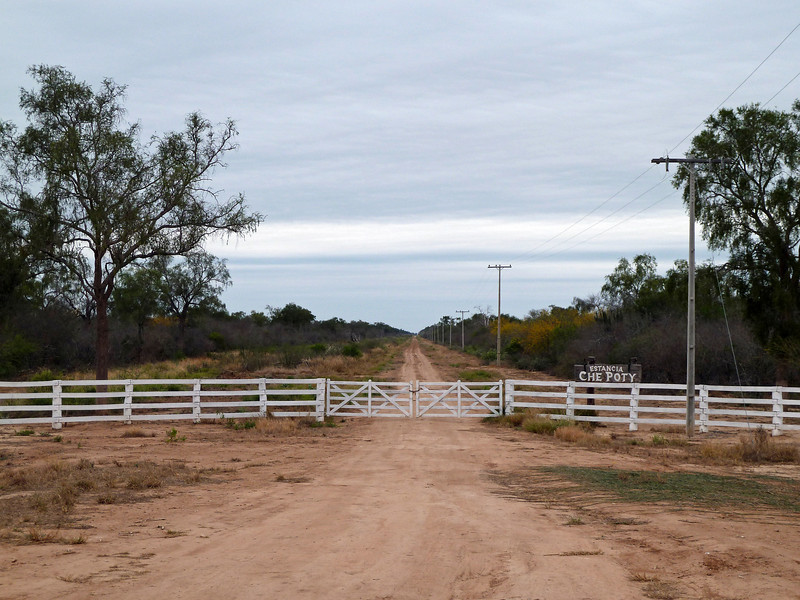
Oh, and there was, of course, a beautiful DRZ… 

I also met two heavily loaded bicycles coming the other way. A French couple, as I learnt later, on a round-the-world trip they had started four years ago. Really impressive, especially considering what a long and boring stretch of road they had ahead of them…
After another 110 kilometres I stopped at a barrier where a soldier asked for my passport, international driving licence and the bike registration. Everything was fine and he waved me through.

Two kilometres further on I arrived at the actual border between Paraguay and Bolivia. It was now around 5pm and I was hoping to find accommodation here.
I was greeted by a group of five border officials – rather casually dressed, all already a bit tipsy but in good spirits. With an average of three vehicles passing every day, I was a welcome diversion to their daily routine.

The customs officer was away but would return any minute, they told me, and so he did. Friendly and efficiently he processed my temporary import documents for the DRZ and sent me on my way.
One moment, señor, excuse me, but where is the Paraguayan exit-stamp in my passport? Well, that you get at the immigration office in Mariscal. What? This cannot be true – Mariscal is 230 kilometres before the border! I could not grasp the concept behind of not being able to receive an exit-stamp at the border when actually leaving the country and was absolutely gobsmacked when I stumbled out of the office. What a nasty surprise…
My new friends offered me some of their high-proof spirit (which I politely declined) and together we considered the options: I could ride straight back and stay in Mariscal but there was only an hour of daylight left – dismissed. One of them would give me a lift there and back for US$ 120.00 – also dismissed. I could carry on into Bolivia and bribe the border official on the other side. The men local to the area shook their heads: the Bolivian guy was a real hardliner and apparently showed no mercy; they had seen people reduced to tears having been sent back from the Bolivian border post in the village of Ibibobo (70 kilometres further on) to get their exit stamp in Mariscal. Ok, I would be thinking about taking this risk.
However, with daylight fading, I had to sleep somewhere and asked if I could pitch my tent behind the barracks. No problem, but the ground was very hard and they had recently shot a caiman in the woods nearby. Mmm, were they pulling my leg? I could sleep with them in their barrack, they had a spare bed. Yeah, right… Then one of them, another Juan Carlos, stepped forward and invited me to stay with him and his wife in a separate hut for free which I gratefully accepted.

This hut consisted of a bedroom, a bathroom with toilet and running cold water, and an office with desk and chair where I could spread my sleeping bag.

Yessime, Juan Carlos’s wife, welcomed me into their home and we immediately started chatting about the life out here in the wilderness among all the men, my trip and the destinations she also wanted to see one day. After a while the boys came over and invited us to have dinner with them in the canteen. They served a delicious stew with the meat of an antelope that they had hunted the previous day.
Afterwards I was asked into the commander’s office and allowed to use the only computer to write an email to Steve telling him about my whereabouts and that I was well. The officer encouraged me to just try and get over into Bolivia without the exit-stamp – I might have to pay some US$ 20 as a bribe but that would be a lot cheaper and less time-consuming than going back to Mariscal.
Well, I thanked him very much and went to sleep over the options. He might be right but then, he had only recently arrived from Asunción and didn’t know the officer on the Bolivian side. Decisions, decisions…
What would you have done? 

Norma seemed really pleased that I was so interested in their life in the Chaco and made me a typical breakfast in the morning: tortilla, Quinoa pancake and a lighter version of yerba maté. It was a lot to eat but I made an effort to finish it all!

It’s nice to know where your eggs come from…

I didn’t really want to leave this peaceful place where I had learnt so much, but finally I packed, paid less than £6.00 for accommodation and food, took some more photos and hit the road.
This little boy is the son of the Guaraní couple but I didn’t understand his name.

Another little fellow…

The Ruta 9 was still long and straight…

Learning from yesterday’s experience, I stopped at the next filling station – but again, they only had 85-octane fuel and not the 95-variety. The onward journey promised to be interesting… 
The next garage was 100 km further north-west at the junction to Loma Plata. They had 95-octane petrol and while filling up I saw something very intriguing: road signs in German! In the midst of the wild Chaco!

I hadn’t made my mind up how far I wanted to go that day, but there was surely time to follow those inviting signs to Loma Plata. Along the perfectly tarmaced road I saw more traces of German settlements.

Yes, I had heard about the Mennonite Communities in South America but I didn’t know who they were, why they had settled here in the Chaco and how they were living today. So when I came to Loma Plata, amazed by the German street names, German shops and German tidiness, I stopped at the local museum to learn more about the history of the community.

That’s Franklin Klassen, the museum’s attendant, reflecting both the Prussian and the Canadian traces in his ancestors’ history in his name.

When I asked him in Spanish if I could visit the museum, he replied in German and then took a lot of time to tell me the saga of the Mennonite colony.
In the 1760’s Catherine the Great of Russia invited Mennonites from Prussia to settle north of the Black Sea in exchange for religious freedom and exemption from military service, a precondition founded in their commitment to non-violence. After Russia introduced the general conscription in 1874, many Mennonites migrated to the Americas. The members of the Colonia Menno (of which Loma Plata is the largest town and administrative centre), settled first in Canada until a universal, secular compulsory education was implemented in 1917 that required the use of the English language, which the more conservative Mennonites saw as a threat to the religious basis of their community. 1743 pioneers came from Canada to Paraguay in 1927 and turned the arid Chaco into fertile farmland over the years. Today Loma Plata is home to a thriving agricultural co-operative with an impressive dairy production. The main language of the community is still the German dialect Plautdietsch although everyone speaks Spanish, too.
If you are interested, here is some more information about the Mennonites in general and about the Colonia Menno and Loma Plata in particular.
The early settlement efforts are well documented.

A bible in Gothic print from the first pioneers – the Fall of Man

A children’s catechism

Franklin Klassen’s parents both played an important role in the development of the health service in Loma Plata: his father was the first local pharmacist and anaesthetist; his mother worked as a nurse in the only hospital in the area; it was built in 1947 while the other Mennonite colonies Fernheim (Filadelfia) and Neuland were still reluctant to employ professional medical care which they regarded as interference with God’s will.

Although I found some of the rules and decisions difficult to agree with, I was amazed by the enormous achievements of these pioneers. The conditions under which they survived had been incredibly tough and still, their faith gave them the strength to endure all the hardship and pursue their visions until, after decades, they had transformed the desert into prosperous farmland. This sculpture commemorates their endeavours.

I spoke to a few more people in the garden and then, although I had only ridden 130 km / 80 miles that day, the temptation of staying in a place where I could speak my own language for a while became just too much to resist. Usually I go home only once or twice a year so the prospect of a German environment was a luxury which I don’t enjoy very often. Herr Klassen recommended a reasonably priced hotel and a few minutes later I arrived at the Hotel Mora (Sandstrasse 803, by the way), being welcomed by the Sawatzky-family.

They had rooms for PYG 80,000 (£11) or PYG 120,000 (£16.30) but I was absolutely happy with the cheaper ones: en-suite, air-condition, breakfast and all immaculately clean. After fixing the internet connection I was even able to use the PC at the reception and inform Possu that I was still alive.
While updating my SPOT message and uploading photos I got talking to Annette, a member of the hotel staff. She had grown up in Frankfurt am Main, met an Argentinean, moved to South America, got married and had two kids with him. Her problems started when they divorced and the father was given custody of their children – possibly because she as a foreigner couldn’t provide the support of an extended family over here. Annette’s ex-husband then moved to Paraguay and she followed to be closer to her children, who she only saw once in a while though.
As she was not a member of the Mennonites and had no intention to become one, it was very difficult for Annette to find a decent job and somewhere to live in Loma Plata. Although she was a qualified banking professional as well as a management assistant for the hotel industry, she could count herself lucky to have secured employment as a chamber maid at the Hotel Mora. Her salary was correspondingly low and she wasn’t really integrated in the community. Her parents, although seasoned travellers, had not visited her once in the seven years she had been living in Paraguay. It was quite a sad story but Annette was still radiating the amazing energy of a woman who would never give up and always try to find a way.
Annette helped me doing my laundry, even the inner liners of my motorcycle suit which, due to the high temperatures, really needed a wash. Showered and changed I set off to explore the town on foot. When I was about to leave the premises Juan Carlos, another guest of the hotel, tried to engage me in a conversation, but I couldn’t help thinking that he just assumed that I, as a solo-travelling woman, would be most grateful for some male attention. Well, I wasn’t actually and cut him short: sorry, daylight is fading and I still would like to take some photos.
On my way into the town centre I met a lot of friendly people, more often greeting with “Hallo” than “Hola”. Although Loma Plata has 5,500 inhabitants, it seemed that everyone knew each other – rather like in a small village. In fact, the place still had a very rural feel to it.

And then there were those familiar street names everywhere – Hill Road…

Well-tended gardens

… and interesting road signs using a traffic light scheme to clarify the rights-of-way.

Although a quarter to six, it was still very hot.

In the supermarket of the Cooperativa Chortitzer, the main social, administrative and commercial institution of the Menno Colony, I indulged in the extensive range of dairy products, fruit and vegetables. Still, having only restricted luggage space, I restrained myself to the basics: biscuits to keep me going during the day, porridge for breakfast should I be stranded overnight (for dinner I had already bought spaghetti and tomato sauce in Buenos Aires), and a cheap toothbrush to clean and lube the DRZ’s chain.
I love supermarkets in foreign countries – you can learn a lot about the habits and preferences of the locals. Happily wandering around, completely absorbed by the variety of typical goods on the shelves, I didn’t realise that it was already after closing time until a polite shop assistant asked me if I was looking for something in particular… 
It was still hot outside.

Another testimony to the community’s past

On the way back to the hotel I met Juan Carlos again: would I have dinner with him? Not right now, I still had things to do on my bike and in my room, and he shouldn’t wait for me. The hotel owners, Mr and Mrs Sawatzky, were sitting in the courtyard and we started talking about their life in Loma Plata. They both had been born in the community; they had never lived anywhere else and didn’t have any inclination to travel – they learnt enough from the visitors coming from all over the world to stay with them. The two were quite doubtful if it was a good idea to travel through the wild Chaco on my own, as the road would become more and more remote and a lot of dubious characters would use the Ruta 9 being up to no good. Oh dear… 
In the afternoon I had met Fritz, a waiter in a restaurant nearby, and he had suggested that I should come to dine at their place La Delicia, the delight, later. The menu looked good and Fritz showed me a nice table in the air-conditioned interior – it was still too hot to sit outside. Fritz was a descendent of Brazilian Mennonites in the 6th generation, he spoke German, Portuguese, Spanish, English and Guaraní, and he was going to be a dad the next day! How could he still be so calm and continue doing his job?! 
After I had finished a delicious meal, Fritz told me that “my friend” was waiting outside and that my bill had already been paid. No way, that’s out of the question, I’m paying for my food myself, thank you very much! Still, not wanting to be rude, I went into the garden after a while and sat down with Juan Carlos. It’s the custom in Paraguay that visitors are invited for dinner, he said, it doesn’t mean anything, honestly. Yeah, right…
Juan Carlos told me about his job; he lived in Asunción, was employed by a big company and had to travel around the country solving issues with the labourers, especially with the indigenous ones. He spoke in a low voice, slurry and very fast, and although I repeatedly asked him to slow down a bit, I didn’t find out what exactly this problem management implied. Still, he as well warned me about the hazards of the Trans Chaco Highway and the people who I might encounter.
Fritz helped translating and brought me a homemade Flan, a traditional Spanish custard, for dessert – on the house and to celebrate his impending fatherhood. How lovely. Full-up and tired of the effort to make sense of Juan Carlos’s muttering, who was by then pretty drunk, I got up to return to the hotel. Of course, JC wanted to accompany me, possibly because he needed someone to lean on on the way back. He let me hold his beer while he was relieving himself against a lamp-post and then tried to give the conversation a more intimate tone.
Of course, I was having none of it, kept waving my wedding ring at him and then thanked my lucky stars that Mr Sawatzky was still sitting in the courtyard. I quickly turned to him to ask further questions about the route to the Bolivian border. Alas! I heard more unsettling stories… In the meantime, Juan Carlos had fortunately retired to his room but I still passed a very uneasy night, envisioning the perils that lay ahead…
Had I been naive and bitten off more than I could chew?

 Pumpernickel on Tour