Sunday 14 September 2014
When the friendly lady at the ticket office tells us that the 204-kilometre journey from Tupiza to Uyuni will take 8 hours, we already suspect that this route hasn’t been paved since 2010. Our suspicions are confirmed when we see the coach waiting for us –

And surely, after a short stretch on the smooth tarmac that now stretches from Villazón to Potosí, another road branches off to Uyuni.


We sit in the first row having a panoramic view of the breath-taking landscape, the villages and the people living there – but also of the mostly single-track dirt road and its wash board-like surface. We see every tight edge, every landslide narrowing the piste even further, we hold our breath at every blind hairpin bend and the many river-crossings with and without water. On the Altiplano we also meet sand dunes and Llamas running around freely. What more could the adventurer possibly ask for?


Some times I miss not being on my bike…

The road climbs from 2,970 to 4,285 metres above sea level


Next stop: Atocha


Half-time


More than once my dad shakes his head in disbelief that I rode this track on a motorbike and on my own four years ago…


Uyuni!
Thanks to our excellent driver, we already arrive after seven hours at our destination, walk straight to the Hotel Julia where I stayed in 2010 and even get my old room on the third floor.
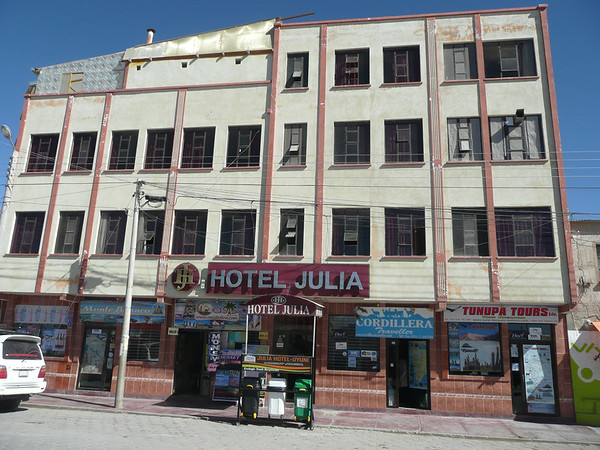


… which offers great views of the main street and the town

Uyuni by night


The Dakar is everywhere
After such an adventurous ride we think that we’ve deserved a treat – our first Llama steak.

Tomorrow we will explore the famous Salar.
Saturday 13 September 2014
A rest day can start with a lie-in – or with editing photos in bed and almost finishing a new post before breakfast. At some point we may abandon our duties and vacate our room (so that it can be cleaned), climb the roof terrace –

– and enjoy Tupiza from above –


Possibly we then go to the bus terminal to organise our journey to Uyuni the next day, followed by a stroll through the central market –


As it would be a shame to spend such a beautiful day indoors, we may carry on exploring the town –

Iglesia Nuestra Señora de la Candeleria

On the main square – Plaza de la Independencia

If you look closely you can see that the letters are made from cactus wood
It could be that we even climb the Cerro del Sagrado Corazón de Jesús –


Seems that there’s a bridge gone missing…

Nobody around who we could ask what happened here…

The Bolivian Coat of Arms

Home country or Death – we will overcome
And, after returning to the hotel and doing some more work, we may still go out looking for a nice restaurant, spot a procession on the way, curiously follow the people to a church and attend a Bolivian service –


Little did we know that we would need all the blessings we could get the following day…
Thursday 11 September – Salta to Humahuaca, Argentina
After an opulent breakfast we leave the Hotel del Antiguo Convento and head for the bus terminal, passing the old convent itself.


The bus takes us north zigzagging through Güemes, Perico, San Salvador de Jujuy, Tilcara and, climbing gently from 1,190 to 3,240 metres above sea level, to Humahuaca, our destination today.
Some impressions from the road –


We still contemplate taking the train occasionally


In Jujuy we have to change buses – the one in front is probably better suited to cope with the altitude. As it is quite a logistical challenge to shift all passengers and their luggage we wonder why they didn’t use the newer model in the first place.


Mmm, it was probably a good idea to stick to the bus…

Welcome to Humahuaca
We find a nice little hotel in the middle of town –


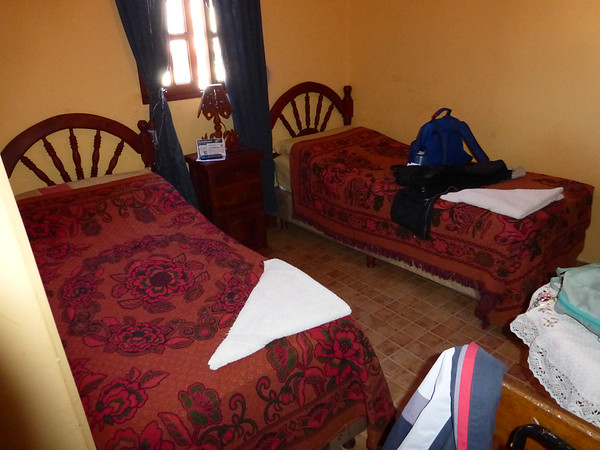
– then we set out to explore the city, which has its own distinctive culture and where the heaviest fighting in the country during the Wars of Independence between 1814 a 1821 took place.

Monumento a los Héroes de la Independencia


Of course, such a special place is also quite touristy


The Town Hall


La Quebrada


The much contemplated railway…


In the evening we enjoy the regional cuisine: aubergine with goat’s cheese and a Quinoa casserole
Friday 12 September – Humahuaca to La Quiaca, Argentina, and on to Villazón and Tupiza, Bolivia

Breakfast is rather frugal – but typical for the region


The bus to La Quiaca, the most northerly town and starting point of the famous Ruta 40, leaves at 10.10 hrs – or 10.40, but we don’t really mind; we are on holiday.


And promptly, half a mile further down the road…

5121 kilometres to Ushuaia…
From the bus terminal it’s less than a kilometre to the border, so we cross La Quiaca on foot to see a bit more of the place.

Ok, we admit defeat – travelling by train is definitely not an option


Both Argentinean and Bolivian immigration offices are conveniently in the same building; we fill in the necessary formularios, get our stamps and walk over the Río La Quiaca into Villazón in Bolivia.


The Dakar Rally has been a huge event in Bolivia

We rest for a few minutes on the main square –

– find the only cash point in town relatively quickly (thanks to Open Street Map on my phone) and head for the bus terminal. We have just asked a local señora if we are in the right place – like in many towns, there are different terminals for local and national/international connections – when we are approached by another lady: Van a Tupiza? Great, that’s exactly our destination today!
We pay the stately amount of 15 Bolivianos (£1.34 / €1.69) for the 90-kilometre journey…

Our luggage is securely fastened on the roof rack

We sit right in the front next to our ‘chofer’…

… and enjoy splendid views


It seems that our chauffeur has spent a bit too much time watching Formula 1 but at least they have paved the road since I’ve last been here on my bike, and so we already arrive after 1.5 hours in Tupiza. One of the many demonstrations in Bolivia blocks the first bridge into town.

Fortunately the activists decide to abandon their protest and let us through. While I am dealing with our luggage, Johannes makes friends with the locals.


The Hotel Mitru, where I’ve stayed in 2010, is only a few streets away and we get an excellent spacious room on the first floor. And the receptionist, Edgar, even remembers me and gives us a good rate.


We feel quite tired from the journey and only leave our accommodation to have dinner at the Churrasqueria Moises – a huge mixed plate with beef filet, chops, chorizo, salad, potatoes and rice.

Tomorrow we will grant ourselves a rest day – Tupiza is such a lovely place.
Due to non-existent Wi-Fi and flaky internet availability in the places we stay, I’m falling more and more behind with keeping you up-to-date on a daily basis. Therefore we’ve allowed ourselves a rest day today and I will give you just a brief overview of our recent adventures.
Tuesday 9 September – Resistencia to Salta, Argentina
We sleep surprisingly well in our modest chamber, head back to the terminal to buy tickets for our onward journey and then take the local bus into town to find a nice little café and have some breakfast.

In the end we spend five pleasant hours in the Heladeria (ice café) Luigi being pampered by the friendly waitresses with café con leche, freshly pressed orange juice and delicious pastries. Apart from indulging ourselves in local delicacies we even get some work done: editing photos, writing our journals and another blog post and sending emails to the loved ones at home.

When the electricity fails (a common occurrence in this part of Argentina), we go for a stroll through the city of the sculptures, as Resistencia is dubbed for its many pieces of art, all exhibited in public places for everyone to enjoy.


We return to the terminal with plenty of time to spare and sit on the terrace watching the world go by until our bus to Salta arrives. It’s almost dark when we set off, so we wouldn’t have seen a lot of the Argentinean Chaco – had it not been for the brightly shining moon.


Although the bus stops often, we still get a good night’s sleep and arrive relatively refreshed in Salta.

Wednesday 10 September – Salta, Argentina

From the terminal it is only a short stroll to the first of the accommodation options I have in mind and Bingo! – we get the most wonderful room of the whole journey so far at the excellent Hotel del Antiguo Convento. It is also the most expensive but I can negotiate a 20% discount and the facilities, the quality of the fittings and the helpfulness of the staff are worth every peso.


Johannes could happily stay here for two weeks… But we have a loop to finish. After settling in we head into the centre of Salta to ask at the tourist office what we should see.

Basílica Menor de San Francisco


Cabildo de Salta

Catedral Basílica de Salta – Santuario del Señor y Virgen del Milagro


Through the park along the Avenida San Martín we walk to the cable car that takes us up to the summit of the Cerro San Bernado, where we have a splendid view over Salta – before descending via the 1021 stone steps back into town.


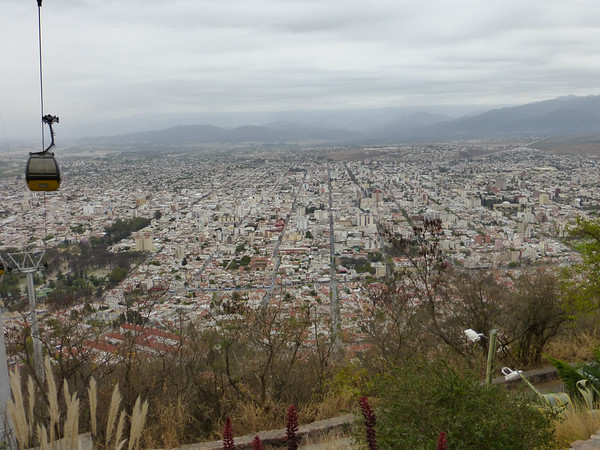


A seemingly harmless bottle tree…

Oops!


We briefly contemplate visiting the village of San Lorenzo, as recommended by the friendly señora at the tourist office, but decide that we’d had enough excitement for the day and return to the Old Convent Hotel. We only leave to have dinner at the Corredor de las Empanadas next door – also well worth a try when you are in the area.

Johannes can’t manage one litre of Cerveza on his own – the things we do for our parents…

Enjoying some excellent local dishes – Tira and Cazuela de Cabrito
Well, after a day in Salta we can say that everyone we have spoken to about Argentina hasn’t promised too much…
We have changed our original itinerary; from Asunción we won’t be carrying on through the Paraguayan Chaco to Bolivia via the Mennonite Communities, but go south again to Argentina and on to Salta in the north-west of the country. Literally everyone I’ve talked to about Argentina told me that I must go to Salta. We will miss one of my favourite places in Bolivia, Tarija, as a result as we will only join the original route in Villazón, but thus I will also see something new.
In the morning we still have some time to enjoy the sights and delights of Asunción.

Pantheon of the national heroes

The Treasury

The Lido Bar by day
Then we catch the first bus of the day to Resistencia, the capital of the Chaco region in Argentina. It should arrive in plenty of time to give us the chance to catch a connecting bus to Salta at either 19.00 or 22.00 hrs.
We have not even left the Paraguayan capital when the bus breaks down…

After two and a half hours we can finally carry on. When we arrive at the border there is a huge traffic jam – six double-decker busses (like our own) are in front of us, each taking half an hour for all passengers to get their exit and entry stamps and have their luggage checked – or searched if they are unlucky.
We are allowed to cross the bridge at José Falcón on foot; and although I know that I shouldn’t, I take a few pictures of the chaos around me. And promptly, when I return to the bridge, I am stopped by an officer who politely asks to show him my photos and delete one after the other…
Dusk is falling when we can eventually travel on. To cut a long journey short, when we arrive at Resistencia it is already 23.00 hrs and all the connections are gone – the next bus doesn’t leave until 18.00 hrs the following day. We are stranded. Now in Europe, you would be accommodated in some nice hotel at the bus company’s cost and be paid some compensation on top but we are in South America (count yourselves lucky the next time you’re about to complain).
The most the bus company can do for us is that the friendly agent walks with us 100 metres from the terminal and shows us a hospedaje they normally use in emergencies like ours. The room is cheap and once upstairs we understand immediately why.


The communal bathroom
It’s already after midnight, the town centre is another five kilometres away and we are absolutely knackered from the journey. So we decide to stay and file this night under Experiences.
The pequeno-alomoço at the Iguassu Central Bed & Breakfast is truly delightful and we’d like to thank my colleague Erika for recommending this hotel – we had a most pleasant stay.

It’s a short walk to the local bus terminal…

… where we wait for the bus to the Ponte de la Amistad (Friendship Bridge) over the Río Paraná, which forms the natural border between Brazil and Paraguay.

After obtaining the all-important exit stamp on the Brazilian side, we cross the bridge on foot.


Immigration formalities on the Paraguayan side are brief and painless and we take another bus to get to the bus terminal past the huge shopping mall that is Ciudad del Este.

After Asunción, Ciudad del Este (city of the east) is the second largest town in Paraguay, fastly growing when the controversal Itaipu Dam was built from 1975 to 1984, the world’s biggest operating hydroelectric facility in terms of annual energy generation, supplying 75% of Paraguay’s electricity and 17% of Brazil’s. The city has also been dubbed Latin America’s biggest shopping centre, attracting thousands of Brazilians and Argentinean with cheap electronics and other goods. According to the South American Handbook 2014, almost any vehicle advertised for sale was stolen in Brazil or Bolivia…
We don’t linger to find out if this allegation is true – we want to reach the Paraguayan capital today. When we get out of the local bus at the terminal, we’re immediately approached by the agents of the numerous bus companies: we have to go with them, their respective bus is the best, has the least stops, the most comfortable seats, the earliest departure. I feel quite stressed by this aggressive sales behaviour; it is unbearably hot, we need Guaraní , the local currency, water and some research in our own time, thank you very much. A young man is especially impertinent, he already writes tickets out for us but, fortunate for us, doesn’t take credit card payment. Going to the cajero (cash point) gives me time to think about our next steps. I really don’t like to be put under pressure, but it’s not mandatory to feel this way: it takes two to create such a situation.
So I try to calm down and then tell the agents in no uncertain terms what I am going to do with my money. In the end we take another bus, which leaves earlier (the young man lied to us about his departure time as well) and seems to be more reliable. I let my dad take the window seat (anything to keep him happy…) and thus in charge of collecting the photographic evidence of the day.
Impressions from the road –


At every stop street vendors enter the bus to sell food, drinks, books and other travel commodities


The Cameraman
After six and a half hours we arrive in Asunción.

We walk the line of bus company counters to find out how we can carry on, when the buses leave and how much they will cost and then take a local collectivo to the city centre (lines 14 and 38 if you want to know). I want to stay at the Hostal Española which I liked very much back in 2010. I have already filled in the registration form and am about to pay when Johannes insists that we look at the room first. And I am grateful he does – the habitación is tiny, crammed, windowless, dirty, there are ants on the floor and mosquitos on the walls and it’s just a nightmare. I look at one other room, which is only slightly better, and find on the way through the long corridors that the whole place has deteriorated considerably in the last four years. We leave in a hurry and I thank my dad profusely for applying some common sense when nostalgia got the better of me.
Fortunately we have seen another hotel on the way and find excellent accommodation there – it’s almost double the price but still good value if compared to European rates.

Showered and shaved we set off for dinner in the famous Lido Bar

We’re looked after by waitress Vicenta that evening, who recommends the best dishes of the day and takes care of everything we could possibly wish for to enjoy ourselves.


There is street music outside the bar
… and we walk through the warm winter’s night (yes, it’s over 30 degrees in Paraguay in their equivalent of early March…)

You have to watch your step though…

The presidential palace, the seat of the Paraguayan government


Many people, teenagers, families with small children, street artists and musicians are out on the Costanera enjoying a lovely Sunday evening.


Hope they are not drunk though…
We walk back to the city centre along the Avenida Republica where you find the slums on one side of the road and the parliament building on the other – so that the politicians don’t forget who they are working for.

Local wildlife…

For size comparison…

Memorial for the Independencia Americana

The Cabildo – City Council, also the Cultural Centre of the Republic
Full of wonderful impressions we fall asleep that night – tomorrow we will return to Argentina and only have the short leg to Resistencia to cover; 334 kilometres and six hours by bus.
Or so we think…
Today is our lucky day. Firstly, our stomachs have fully recovered and we enjoy our breakfast at the ‘Crazy Summer’ hotel: jugo de naranja natural (freshly pressed orange juice), café con leche (milky coffee) and dulce de leche (traditional caramel cream) on tostadas.

With half an hour to spare, we set off to the bus terminal.

Johannes and his adventure trolley
As we approach the station, there is already a bus to Foz do Iguaçu waiting and the driver invites us to get on quickly, sells us the tickets directly and then, when we ask how it would work at the border with Brazil, hands us the necessary immigration paperwork, his pen and board to write on. Other passengers point out where we have to go at the Argentine customs, we receive our exit stamps and then we cross the river, which forms the natural division between the two countries.

On the Brazilian side we seem to be the only ones who need to get out to get our passports stamped (we still have to figure out why), and there appears to be a problem with my entry into Brazil. It turns out that I must have misunderstood the instructions of the border officials back in 2010; I thought that the transit stamp in my passport was enough, as I was only riding through on the 15-kilometre passage to Paraguay, but in fact I would have needed a proper exit stamp. Thus, for the Brazilian officers, I have never left the country…
Oh dear, Johannes is already back in the bus, the driver and all passengers are waiting and I fully appreciate that I am in the wrong. Four more officers get involved in the case, they all discuss what to do with me, the bus driver comes over – after off-loading our luggage – to enquire what the problem is, and I feel very embarrassed. A few more minutes of explanations in Spaniguese on my part and consideration on the official side ensue and then the most senior officer makes an executive decision and lets me enter Brazil – phew, muito obrigada, senhoras e senhores.
I apologise and thank all people on the bus for waiting and we continue our journey into Foz.

We get off opposite the Terminal Urbano and start looking for the Iguassu Central Bed & Breakfast, highly recommended by my colleague Erika. We are already in the correct road, we count the house numbers (a chapter in itself in South American towns) but we fail to spot anything resembling a popular B&B. In the end a helpful shopkeeper points us in the right direction, he even follows us to make sure we really find it; he asks in a drugstore and then, when we stand in front of the locked gate of a inconspicuous building, even uses his own phone to call the number displayed.

Spot the B&B…
The gate opens, we thank our helpful guide very much and enter the air-conditioned reception area, where the friendly owner tells us everything about Foz, its transport system, the average expenditure of the rucksack tourist per day, foreign exchange rates and the gastronomic highlights of the town we ever wanted to know. We are promised the most luxurious breakfast buffet the next morning by a fellow traveller and find that our room is great as well – we are very impressed by Brazil already.
We pack our day-rucksacks and set off to the stop of local bus 120, which arrives after two minutes and takes us the 25 kilometres to the Cataratas.

Johannes enjoys the experience hugely
The Brazilian side of the Iguaçu Falls offers more of a general overview of the natural monument.


The remains of the Argentinean ‘Garganta del Diablo’ view platform – swept away two months ago by high waters
By the time we reach the end of the panoramic trail we are completely drenched but happy and feel very privileged that we can see this wonder of nature in glorious sunshine with our own eyes. Photos don’t do the beauty of this place justice, you don’t hear the thunder, you don’t smell the water and the rain forest – if you have the opportunity go and visit the Iguazú Falls yourself.
On the way back into town we are impressed how may people you can fit into a normal sized local bus; the driver doesn’t let anyone standing at the numerous stops. Every time we think, ok, that’s it, it’s absolutely crammed, another five to ten passengers disappear inside our bus’s belly.
After resting and showering in our lovely hotel, we ask the owner if he can recommend a restaurant within the budget he had drawn up for us in the morning. Well, there is the Buffalo Branco, the best in town but probably outside our price range, and the Churrascaria do Gaucho, a bit further down the road. At first we don’t quite understand how a Brazilian dinner works but the friendly waiters explain what we have to to: help ourselves to side dishes from the voluptuous buffet and then they come round every other minute to offer us cuts of the most tender and delicious different meats you can imagine – until we indicate that we’ve reached bursting point.

Johannes’s delight – warm pineapple coated in cinnamon
Although the means of communication are limited due to our lack of Portuguese, we have a lot of fun with the good-natured senhores at the Gaucho and enjoy ourselves immensely – what a fantastic day full of wonderful impressions and people!

It was a good decision to stay in Brazil for a day and not just nip over from Argentina to see the waterfalls. Tomorrow we will continue to Paraguay.
Fortunately we felt a lot better the next morning, albeit not 100%, but well enough to get up and head for the Argentine side of the Iguazú Falls.
Three surprises awaited us there – the bus fare had increased from AR$5 to AR$40, the entrance ticket now costs AR$215 (US$26 / £16 / €20) and not AR$85 as in 2010, and, worst of all, the most impressive part of the falls, the Garganta del Diablo (Devil’s Throat / Teufelsschlund) was closed – as it had been for the last two months! Poor timing on our part…
Even though, the national park still has a lot to offer and is well worth a visit –


After another short night, we decide to explore a part of Buenos Aires which does not exactly lie on the tourist trail, the Costanera Sur, an ecological reserve on the riverbank of the Río de la Plata.
On the way we stroll through San Telmo again and visit the Mercado.


Then we have another look at Puerto Madero.


Who would have thought?

Costanera Sur

Rio de la Plata and the Buquebus, the ferry to Uruguay

Frugal lunch on the shore

A rather unusual view of the Buenos Aires skyline

Local flora

Back to civilisation

Cafés y pasteles on the Plaza Dorrego…

… San Telmo’s main square


Time to leave for the bus station Retiro; we take the metro, the Subte (Subterráneo de Buenos Aires) .


Retiro Central Bus Station

Onboard tbe coach

Suburbs of Posadas…

Road closure that adds to our ultimately 20-hour journey…


Finally we reach our destination Puerto Iguazú

Looking for accommodation
We find a lovely little hotel for a reasonable rate and start planning the rest of the afternoon – but unfortunately we are soon confined to bed for the remainder of the day; the food on the coach must have been dodgy and we spend the whole night running between cama and baño feeling very sorry for ourselves…
Will we be fit and healthy again to visit the famous Cataratas del Iguazú the next morning, the main reason for coming here and one of the highlights of our trip?
After thunder and lightning during the night, Johannes and I walked from San Telmo through the city to the central bus station Retiro to buy coach tickets for the onward journey to Puerto Iguazú.

Teatro Catalán


Manzana de las Luces

Centro Naval

Plaza General San Martín and Torre de los Ingleses (the tower of the English), since 1982 renamed to Torre Monumental

Traffic Buenos Aires style…

In the afternoon Cristina kindly took a few hours off and accompanied us on a guided city tour.


Palacio del Congreso de la Nación Argentina – Cristina’s place of work

One of the many demonstrations in the capital to improve the living conditions of its citizens

Not much progress has been made in the last four years…

The Russian Orthodox church

Stadium La Bombonera in La Boca

… with strong support in the community


La Boca neighbourhood

That’s how the first houses in this district were built – and people still live in them

And only five minutes from La Boca…

Puerto Madero – the district of the super rich…

… US$ 4,000 per square metre – and the apartments often stretch over the whole floor…

Rush hour


Embassy of Brazil


A piece of home…

Then Cristina had to go back to work…

Avenida 9 de Julio

And as the highlight of a wonderful day, Cristina and John invited us round for dinner.


Master Chef John’s own Octopus – delicious!
Thank you both so much for all your time, your hospitality and generosity – we enjoyed your company immensely!


 Pumpernickel on Tour